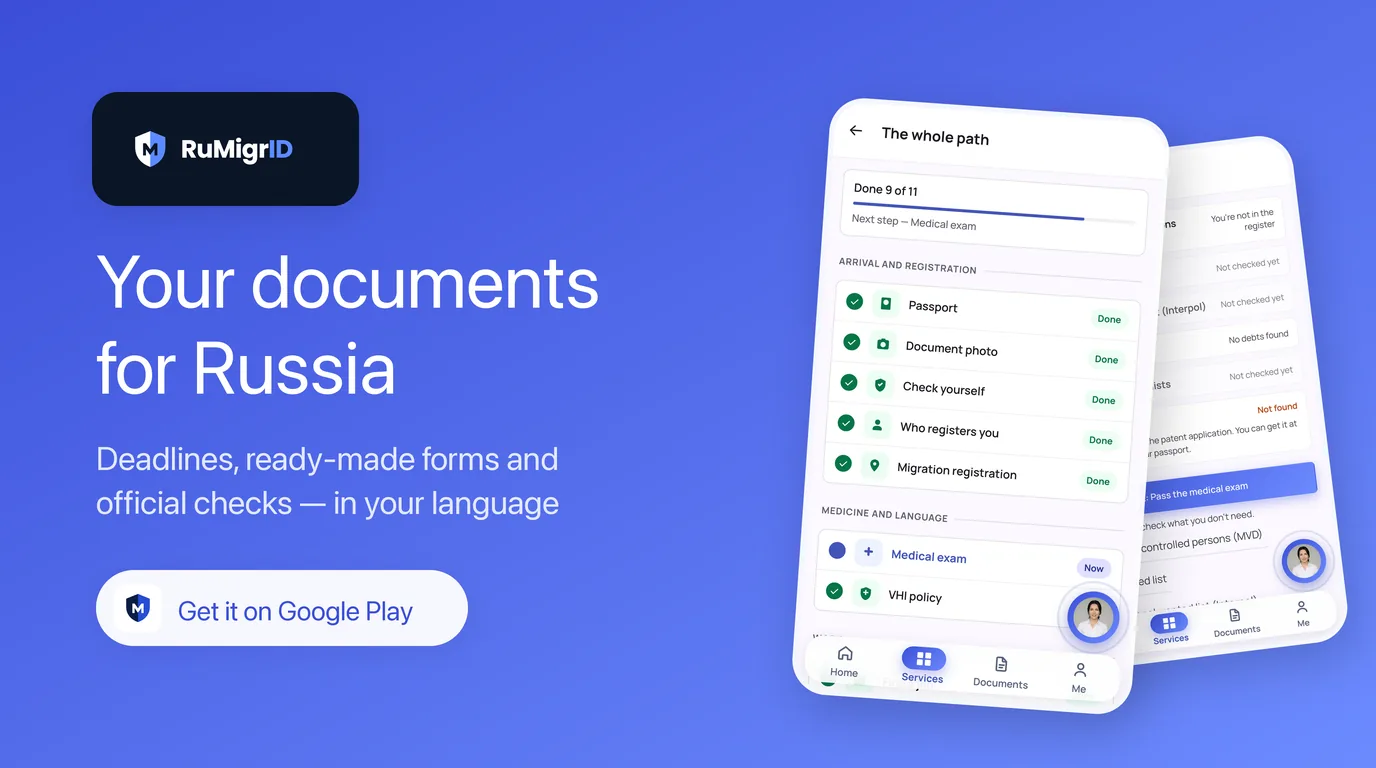
Documents for working in Russia rarely fail because somebody broke a rule on purpose. They fail because a date passed. A migration registration that expired while you were changing address. A monthly patent payment made three days late. A medical certificate that quietly stopped being valid.
What makes this harder than it sounds is when the counting starts. Most of these periods begin on the day you enter the country — not on the day you settle in, find an employer or work out where to go. By the time the first month is over, several clocks are already running.
So the useful order is the opposite of the usual one: settle what you can before you fly, and arrive with the rest already counted for you. This article goes through both halves, and shows how the RuMigrID app keeps every deadline in one place and in your own language.
1. Before you fly to Russia: visa, apostille and certified translations
Two things are far easier to arrange while you are still at home, and painful to fix from Russia.
The visa. If you are coming on a work visa, it is issued before departure, together with the invitation and the application forms; a mistake in the paperwork at this stage costs weeks. Consul.online works with exactly this: Russia visa application — online help and consulate support.
Documents issued in your country. A diploma, a certificate of no criminal record, a birth or marriage certificate is not accepted in Russia as it is. Depending on the issuing country it needs an apostille or consular legalisation, and then a translation certified by a notary. A missing apostille has stopped more than one employment contract. The routes are set out in apostille, document legalisation and certificate for return to Russia.
This is also the right moment to install an app that tracks migrant documents and deadlines in Russia — not after arrival. Set it up on the plane or before it, and the countdown begins with you already knowing your dates instead of discovering them a month later.
2. Work permit, patent or EAEU: which route applies to you
The most common mistake after arrival is following instructions written for somebody else. The list of documents is not the same for everyone:
- Visa-free countries — migration registration, medical examination, fingerprinting, the exam, and a patent, which then has to be paid for every month.
- EAEU citizens (Kyrgyzstan, Kazakhstan, Armenia, Belarus) — no patent and no exam. Registration and an employment contract, and the route is considerably shorter.
- Work visa — a work permit rather than a patent, with its own set of documents.
RuMigrID determines your route from your citizenship and shows only the steps that apply to you. You see what is already done, what is next and what is still ahead — as a list, not as a rumour from a colleague whose situation was different from yours.
3. Ministry of Internal Affairs forms, filled in from your documents
Notifications and applications for the Ministry of Internal Affairs are where most time and most mistakes are lost. The forms are in Russian, they change, and one wrong digit in a passport number sends the whole document back.
In the app you photograph your passport or migration card once. The data is recognised and the fields fill themselves. The app then assembles notifications and applications on the current official forms, using your own data. You download the completed form and submit it yourself — the app prepares documents, it does not go anywhere on your behalf.
Document photos in 3×4 format are made in the same place: take the picture in the app and print it.
4. Paying the patent without guesswork
The patent is kept alive by a monthly advance personal income tax payment. Miss it, and the patent stops working — not as a penalty imposed by somebody, but automatically.
The app pays it directly: the payment details and your regional code are filled in for you, the amount is calculated by month, and the receipt is stored where you can find it again. The reminder arrives before the date, with enough days left to act on it.
One thing worth stating plainly: the money goes to the state budget as tax. The app exists so that the details are right and the day is not missed — the tax itself you pay to the state.
5. Check yourself in official databases before anyone else does
It is far better to discover a problem on your own phone than at a document check. In one action the app checks:
- the register of controlled persons of the Ministry of Internal Affairs;
- wanted lists, including Interpol;
- enforcement debts held by bailiffs;
- Rosfinmonitoring lists;
- the validity of your patent;
- your INN and SNILS numbers.
You can also check the person registering you and the address they are using, before the documents are submitted — a mistake in the host's details is one of the most ordinary reasons for registration to be refused.
6. The exam: Russian language, history and the basics of law
For those who need it, the app has a trainer with two modes: practice by topic, so you can see which subject is weakest, and a mock exam run under the same rules as the real one. It is a rehearsal rather than a summary, and it tells you where you actually stand rather than where you think you do.
7. Medical certificates and the VHI policy
Medical documents have their own validity periods, and they expire silently. The app shows which conclusions are required, how long each remains valid, and reminds you when the time comes to renew. If you already hold a VHI policy, attach it and the app will watch its expiry date too.
8. Giving documents to an employer without giving away your originals
When an employer asks for your documents, you send a link or show a QR code. They see what they need to see; the originals stay with you, and copies of your passport do not spread through messenger chats.
If you are still looking for work, a short profile in the app goes to a recruitment agency, and a broker contacts you.
9. Questions about the patent, registration and deadlines — answered in your language
Vera is the built-in assistant. You can ask in ordinary words — “when do I pay for the patent”, “what do I do if I lost my migration card”, “how long can I stay” — and in any of the app's six languages.
What makes her useful is that she knows your situation: your citizenship, the stage you have reached, the documents you have already uploaded. She answers in plain language and points to the next step. Her answers are for information only and are not legal advice.
10. Languages, price and how to download RuMigrID
The app speaks Русский, oʻzbekcha, тоҷикӣ, кыргызча, हिन्दी and English. Everything — the interface, the assistant, the reminders — works in the language you choose.
You can start free of charge: the assistant answers, documents are recognised and deadlines are tracked without payment. Advanced features are paid. There is also a “Refer a friend” offer: three free months each, once your friend signs in and uploads an identity document. The offer runs until 31 December 2027; the full terms are in the promotion rules.
RuMigrID is available on Google Play, and it also runs in a browser with no installation at all. There is a full description of what the app does, screen by screen.
11. Is RuMigrID an official app? What it is and what it is not
RuMigrID is a private service (a trade name of the MigroDesk service; operator — АО ИКЦ «Консул»). The app is not a government agency and is not affiliated with any government agency. It helps you prepare documents and keep track of deadlines, but it does not replace contacting the official authorities — only they make decisions on your documents. It is not the official ruID application and does not replace it.
Official sources remain the Ministry of Internal Affairs of Russia (мвд.рф) and the Gosuslugi portal (gosuslugi.ru).
Short answers about working documents in Russia
When should I install the app — before or after arrival?
Before. The periods that matter are counted from your date of entry, so the app is most useful when it already knows your dates on the day you land.
Do I need a patent if I am an EAEU citizen?
No. Citizens of Kyrgyzstan, Kazakhstan, Armenia and Belarus work without a patent and without the exam. Migration registration and an employment contract still apply.
What happens if I pay for the patent late?
The patent stops being valid. It is not a fine that someone decides to issue — the document simply stops working, which is why the payment date matters more than the amount.
How do I check whether I am in the register of controlled persons?
The check is made against the Ministry of Internal Affairs database from your passport details. In the app it runs together with checks for debts, wanted lists and the validity of your patent.
Does the app submit documents for me?
No. It prepares completed forms on the current official templates; you submit them yourself. Decisions on your documents are made only by the official authorities.
Checklist
Before you fly to Russia
- Visa and invitation, if you are coming on a work visa — arranged at home, not on arrival.
- Diploma, certificate of no criminal record and civil status documents — apostille or legalisation, then a certified translation.
- Install the app and enter your entry date, so the countdown starts with you.
The first weeks
- Know which route applies to you: visa-free, EAEU or work visa. The lists are different.
- Migration registration — check the address and the host's details before submitting.
- Medical conclusions and VHI policy — know their expiry dates, not just that you have them.
Every month afterwards
- Patent — pay the monthly advance payment before the date, and keep the receipt.
- Check yourself in the register of controlled persons and for debts from time to time, not only when something goes wrong.
- Keep your originals. Share documents with an employer by link or QR code.
RuMigrID — documents and deadlines for working in Russia is free to start: the app is on Google Play and also runs in a browser, with no installation.